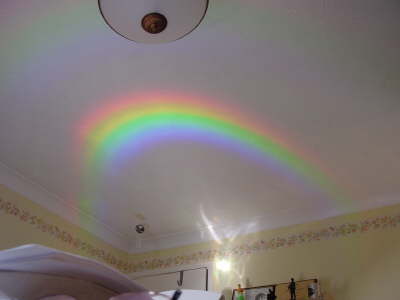
Rainbows a bit about them
These extract are taken from http://haldjas.folklore.ee/folklore/vol6/rainbow.htm
Usually the interpretation of the rainbow by an ordinary Estonian is as follows: "Rainbow is seven colours in the sky. It is a phenomenon which makes its appearance when it is raining at the same time when the sun is shining."
In Latin there are several different expressions denoting
rainbow: arcus pluvius 'rainbow', arcus caelestis 'bow of the
heaven or gods', arcus coloratus 'coloured bow'. One can also refer to
the Greek word  In Greek mythology Iris was the
daughter of Thaumas and Electra, the sister of harpies and a messenger of
Olympian gods. Since Hesiodos she has been represented both as a goddess of
rainbow and its impersonation. At the same time the rainbow could be the belt of
Iris and a footpath between heaven and earth. The original meaning of the word
iris is 'path, band'.
In Greek mythology Iris was the
daughter of Thaumas and Electra, the sister of harpies and a messenger of
Olympian gods. Since Hesiodos she has been represented both as a goddess of
rainbow and its impersonation. At the same time the rainbow could be the belt of
Iris and a footpath between heaven and earth. The original meaning of the word
iris is 'path, band'.
One of the most interesting mythological presentations of
rainbow is the Eddic Bifr st (or Bilr st, Bilfr st). In the Younger Edda it is
described as a tricoloured bridge to Asgard, very skillfully built by the gods.
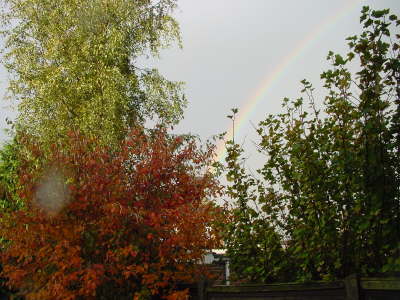
The colours are not mentioned, but the bridge is very strong and destroyable
only by the sons of Muspel, the giants of fire as it happened in V lusp .
Bifr st was kept guard by Heimdall, one of the Aesir, 'who casts bright rays'.
In the Younger Edda there is also a remark, that the Bifr st appears red as
there is a burning fire on it to show the way to Asgard (Gylfaginning XIII, XV).
The most wellknown rainbow representation in the European cultural area is the
version in the Bible, where the rainbow is the sign of the covenant between
Jehovah and Noah: I do set my bow in the cloud; and it shall be for a token
of a covenant between me and the earth (Genesis 9.13). The Old Testament
treatment of the rainbow is ambiguous denoting both Gods wrath and mercy. In the
Old Testament there is likewise found an image of Jehovah's bow with which he
sends arrows to the earth to punish the misdoers. It can be explained by the
earlier Hebrew mythological motifs, where the rainbow was connected with bow and
the arrows with lightning.
In the New Testament the rainbow appears in a new relation. It is a symbol of the covenant between God and people which has expanded to Christ as an establisher of the new covenant. And he that sat was to look upon like a jasper and a sardine stone: and there was a rainbow round about the throne, in sight like unto an emerald (Relevation 4.3). Still, in the Bible there is found no reference to the colours of rainbow or to the number of them. Apparently with these apocalyptical motifs the rather popular role of the rainbow in the late Gothic painting can be explained. In Romanesque art it is possible to associate the rainbow with mandorla or halo surrounding the body of God or a saint. In Gothic art Christ is depicted sitting on the rainbow in scenes of Last Judgement as Maiestas Domini, it is the Lord's throne.
A couple of Estonian riddles are referring to the colours of the
rainbow, as generally the connection between an object and its colour is much
more common to the riddles. The most characteristic ones are:
(I) Punane puuder, sinine siider, ripub rikka mehe r sta all (< J e) or
in Finnish Sininen siirto, punainen puurto, keskell kamarin kattoa (Korhola
1961). This riddle is hardly translatable, but broadly speaking, the rainbow is
described here through two colours, red and blue.
(II) le ilma pihelgas (Eisen 1913:1110) 'The rowan-tree over the world'.
(III) Seitse linti le ilma seotud? (Eisen 1920:215, E 46993 (5) < Saarde)
'Seven ribbons bound over the world'.